Remote Measurement, Management & Analysis for Facial Movement
The Problems We Address
Give Back Confidence
Increase confidence to engage with social activities
Lack of Objective Data
Lack of objective data regarding facial movement
Unknown Compliance
Inability to track adherence to exercise programs
Reluctance to Complete
Reluctance from people to complete unmonitored paper-based routines
How It Works
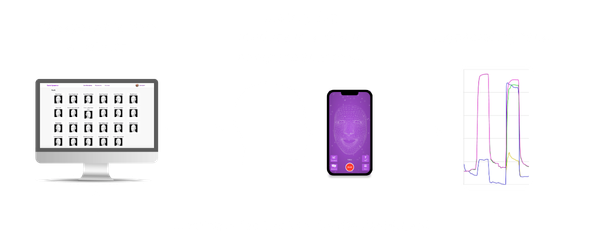
Facial Dynamics provides an end-to-end remote measurement, management and analysis system allowing users to create routines of facial movements and poses to be assigned to complete at home.
The team has been building systems like this for over 10 years.
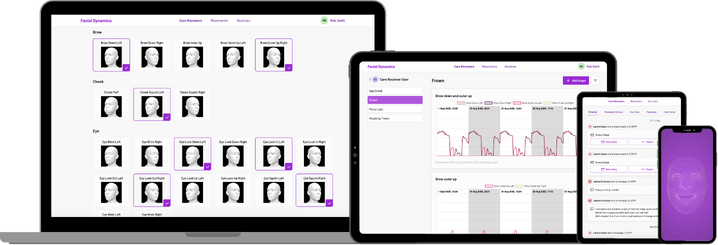
The website provides a dashboard where you can manage user details, their routines and their progress against the user’s exercise plan.
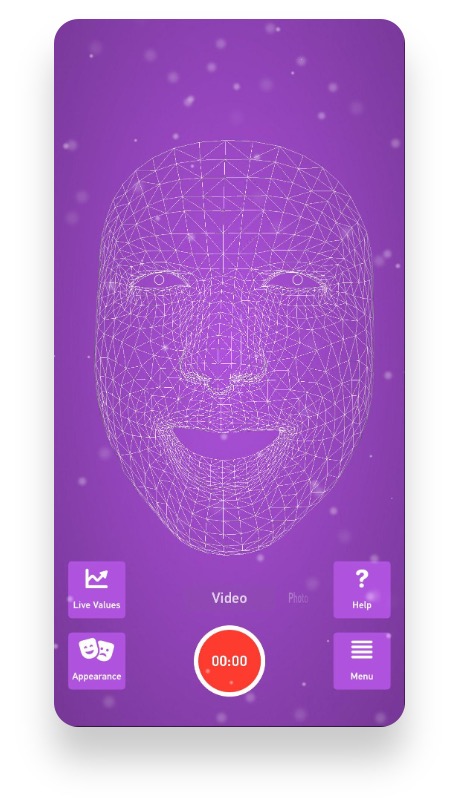
The mobile device, a standard handheld phone or tablet, records the user’s assigned facial movements and sends that data instantly to the dashboard where the information, including detailed motion graphs, will be analysed.
Approximately 30,000 people per year in the UK are undergoing facial retraining and strengthening to regain facial movement
- Many require therapy
- They will typically receive 2 hours of therapy per week
- This is half of the target gold standard.
Who Could Benefit?
Supporting improvement
Now available now for everyday use, pilot and trials
Tracking facial movement used to mean waiting for an appointment.
Changes in-between appointments were difficult to record and were subjectively assessed after they have happened.
Facial exercises can seem daunting and complicated, but Facial Dynamics now makes this process continuous, objective and accessible – giving you and your care team the information they need, when they need it.
Facial Dynamics is available now
If you would like a demonstration of the now-complete end-to-end Facial Dynamics platform please contact us on the form at the bottom of the page, call us on the number in the footer or go to James’s calendar to book 30 minutes with him at your convenience.
Who thinks it’s a good idea?
Prof Alex Leff
Professor of Cognitive Neurology, University College London Hospitals
Prof Andrew Bateman
Professor of Rehabilitation, University of Essex
Prof Arshad Majid
Professor of Cerebrovascular Neurology, University of Sheffield
Prof Audrey Bowen
Neuropsychological Rehabilitation, University of Manchester
Prof Avril Drummond
Healthcare Research, University of Nottingham
Catrina Neville
Lead Physiotherapist, Facial Palsy Therapy, Queen Victoria Hospital
Charles Nduka
Plastic, Reconstructive, and Restorative Surgeon, Queen Victoria Hospital. Co-Founder of Facial Palsy UK Charity
Dr Claire Rosten
Research Methodologist, NIHR Research Design Service
Dr Dan Swan
Cofounder and CEO RealAR
Dr Fraser Philip
Human Movement & Assistive Technology, University of Liverpool
Janet Robb
Lives with Facial Palsy, Enablement Director at ANS
Prof Jag Dhanda
Consultant Oral & Maxillofacial/Head Neck Surgeon at Queen Victoria Hospital
Liesbet Desmet
Facial paralysis technology, Artevelde University of Applied Sciences
Lisa Beaumont
Stroke Survivor, Regional Representative for Different Strokes Charity
Dr Liz Boaden
Fellow of the Royal College of Speech and Language Therapists, University of Central Lancashire
Dr Lloyd Bradley
Consultant in Rehabilitation Medicine, University Hospitals Sussex
Monica Fawzy
Head & Neck Reconstructive Surgeon, Norfolk & Norwich University Hospitals
Prof Pamela Enderby
Community Rehabilitation, University of Sheffield
Ravi Purohit
Craniofacial Orthoptist, Oxford University Hospital
Dr Rebecca Fisher
Stroke Association Senior Lecturer, University of Nottingham
Rebecca Kimber
Speech & Language Therapist, University College London Hospitals
Prof Rebecca Palmer
Communication and Stroke Rehabilitation, University of Sheffield
Rebecca Williams
Physiotherapy Clinical Lead, Alder Hey Children’s Hospital
Richard Cave
Project Manager, Motor Neurone Disease Association
Dr Robert Simister
Consultant Stroke Neurologist, University College London Hospitals
Ruben Kannan
Consultant & Clinical Lead, Facial Palsy Unit, Queen Victoria Hospital
Sarah Kilcoyne
Speech & Language Therapist, Oxford Facial Palsy Clinic, John Radcliffe Hospital
Seyma Calisgan
PhD in Speech & Language Therapist Role in Stroke Rehabilitation, University of Essex
Dr Terry Quinn
Honorary Consultant Physician in Stroke, University of Glasgow
Dr Theopisti Chrysanthaki
Lecturer in Integrated Care/ehealth, University of Surrey
Wendy Blumenow
Speech & Language Therapist, Alder Hey Children’s Hospital
What People Say
I’m an advanced Speech and Language Therapist. My past experience is varied but now I work in adult neuro rehab settings:
NHS Community Stroke Rehab in Staffordshire
Independent practice in the community in the West Midlands region
Neuro Rehab at Circle Health Group
My speciality is stroke rehab but I also work with patients with a variety of different neurological conditions and most of my patients do have acquired facial weakness and would likely benefit from facial rehab in this format.
My patients vary in age but most use tablet and phones with other apps to support communication rehab so this would be appropriate. I see many who are of working age, many do have mood related issues resulting from their disease and usually they describe their facial weakness as contributing to their confidence dip.
In my mind I see it as being a feedback tool to aid patient to achieve measured goals for facial rehab. Most of my patients ask for something tangible to measure improvement against. I feel like this app would help patients see the asymmetry in their face and provide them with targets to aim for in a gradual way.
Mark Chalmers
Speech and Language Therapist
Adult Conversations Speech and Language Therapy
With one patient, who had a left-sided facial weakness, and as they were doing mouth smile on the left and right (looking at) some of the measures that come up on the app, I said to them “Is there anything that you think you can do aside from these exercises that might bring the lines (on the app) closer together?” And just by looking at it they were able to do just that. I don’t know how but they could bring the lines closer. There was still a gap and you could still see that there was some weakness, but actually seeing that feedback on (the app) was really good. I said to the patient, “Well, remember how you did that, and try to do that again.” The patient then used this as their own sort of therapy exercise and took that forward.
Patient treated by Mark Chalmers
Speech and Language Therapist
Adult Conversations Speech and Language Therapy
So I had a 5AM start this morning, and nobody likes those. So that flight was to get me from Belfast to Gatwick and then Gatwick onto Queen Victoria Hospital in East Grinstead. And the reason for that is I attend a facial palsy clinic here with specialists who know everything there is to know about facial palsy. This clinic allows me ability to be able to blink, be able to eat, speak, and deal with the nerve pain and the spasms that I have because of my facial palsy. There’s 62 reasons why you can come to this condition, however in Northern Ireland there is no services for facial palsy whatsoever. This was a half hour appointment, and over 18 hours it will take me from door to door. I will continue to push for services for people with this condition, and that we get this sooner than later.
Janet Robb
Facial palsy sufferer
This is a very interesting tool, and I can definitely see its potential. As a speech-language therapist working primarily with children, I’m intrigued by its possibilities.
I can imagine how it could be adapted to support children with oral motor delays or childhood apraxia of speech. For example, incorporating elements like animated characters or avatars could make speech exercises more engaging and motivating for young clients.
My current assessments include evaluating children’s oral motor skills. I believe your app could be particularly useful in helping children practice tongue movements outside of the mouth, such as tongue elevation.
I’m also interested in the potential of adding an audio component to the app. This would allow clients to reflect on the sounds they produce in relation to their visual feedback, enhancing their self-awareness and self-correction skills.
I’ve been working as a speech-language therapist for 30 years, balancing my time between individual and school-based therapy.
Thank you for your time spent developing this promising tool. I wish you all the best in its continued development.
Rachel Barton
Independent Speech and Language Therapist
Professional Supervisor
I’m very excited about the app because there has been a huge void in the assessment of patients with facial palsy. More specifically, there has been no ready means of objectively quantifying impaired facial movements to date. The solutions that have been developed previously have all been unobtainable, due to high cost, for even our supra-specialist NHS-based facial nerve service.
The lack of a widely accepted and widely-used tool for objectively quantifying facial movements has meant that services like ours have been unable to get an accurate baseline profile of patients’ facial impairments and unable to gauge subtle gains secondary to treatment. Patients probably think it is unacceptable that, in our high-tech world, assessments of facial function have remained highly subjective and of poor resolution. Moreover, research into treatments (both conservative and surgical) for facial palsy has no doubt been stunted and/or stilted by the lack of measurement objectification.
I could see the app, [and the platform you are developing] if validated, being used routinely alongside patient-reported and clinician-rated outcome measures already in use, allowing for a clear picture of facial function to be gained. In our service, we would use the app during almost all appointments in the Facial Nerve Clinic, the multi-disciplinary front-end clinic of our facial nerve service. We have long waiting lists for both new and returning patients, so we would probably recommend to a large number of them that they download the app to monitor their progress during the ~5-month periods in-between successive clinic appointments.
My physiotherapy team sees about 140 patients with facial palsy per year, about 60% of the total number who pass through the front-end Facial Nerve Clinic each year. I could envisage that a platform like yours might be developed to facilitate patients’ rehabilitation programmes as well as their assessments. The fact that the app can produce a mirror-symmetric on-screen face, both sides of which move in tandem with the movements of only the unaffected side of a patient’s face, could be very helpful in the acute phase of facial palsy, as has been indicated by the research of Sarah Martineau in Canada. If her research continues to yield positive results, it’s possible that an app like yours might be part of the recommended measures given to patients attending Emergency Departments very soon after the onset of their palsies.
Dr Jeremy Corcoran BSc MSc PhD
Clinical Specialist Physiotherapist – Vestibular and Facial Therapy
Physiotherapy Department
Guy’s and St Thomas’ NHS Foundation Trust
Why it’s Wanted by Others
- To improve confidence to socialise and work
- To reduce demand on services
- To allow care teams to focus on other priorities
- To provide objective data
A Therapy First: Digital Mirror Therapy
Mirror
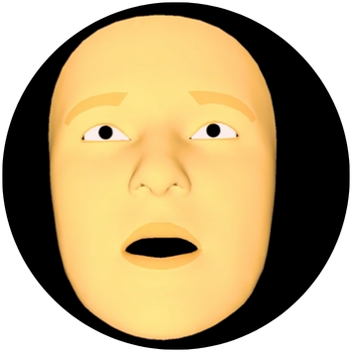
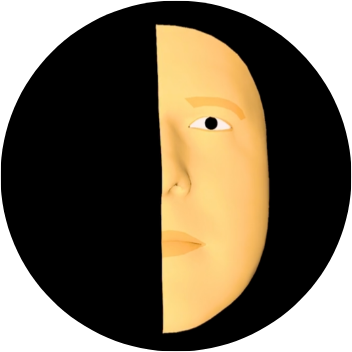
Facial Dynamics is pioneering Digial Mirror Therapy in response to demand. Easy and accessible – no real mirrors needed! – for anyone with a mobile device.
Obscuring
With Facial Dynamics you can choose to mirror one side of the face onto the other (left, right, top, bottom) or obscure the affected side altogether. Contact us for a demo here.
Contact Us
Facial Dynamics is a product creation of Life Analytics Ltd
Facial Dynamics is a UK Class I medical device, self-certified by Life Analytics Ltd in accordance with the UK Medical Devices Regulations 2002.
The device is registered with the MHRA and UKCA marked.

Consult your healthcare professional regarding your health and use of the Facial Dynamics.
2026 Facial Dynamics.